Sunday, August 23, 2020

Some Stray thoughts regarding Mid August 1947 events & unheard story of a Punjab Assembly document ( A radio show)


Some Stray thoughts regarding Mid August 1947 events & unheard story of a Punjab Assembly document. Check Who voted for the partition of the Punjab in 23rd June sessions.

( A radio show Lok Lhar, every Friday 2 to 4pm)

Out of 170 members 91 Punjab assembly members including 89 Muslim & two christian members voted against the partition of the Punjab. So more than 50% Punjab assembly members including non Muslim  leaguers voted against the partition of the Punjab in 1947. 

Politics of last 31 years, from misleading Lucknow Pact of 1916 to Mid 1947 in the Punjab & Bengal overshadowed all other issues yet it was fought under the banners of One Nation Theory (ONT) & Two Nation theory (TNT). It is important to deconstruct whole politics of 31 years in general and last 10 years in particular. How Lucknow Pact had ruined our politics is on record either we like it or not. Due to Act of India 1947 two new Nation States were born. That act was passed by British parliament in haste yet they debated it for a month or so. The act is not included in our textbooks due to various reasons. The act was designed on 3rd June Plan as agreed by Congress & Muslim League in 1947. ٰIn spite of all, both Congress & ML were reluctant supporters of 3rd June plan but these things were not taught in post 1947 text.  In the  end there is a document and a link that will tell you that Punjabi Muslim members of British Punjab assembly did not vote in favor of partition of the Punjab while non Muslim members voted for it. 


Recording of the lok Lhar Show recorded at 14 August 2020 in Lhore Studios of MastFM 103

https://voca.ro/gb0YvVRhaml


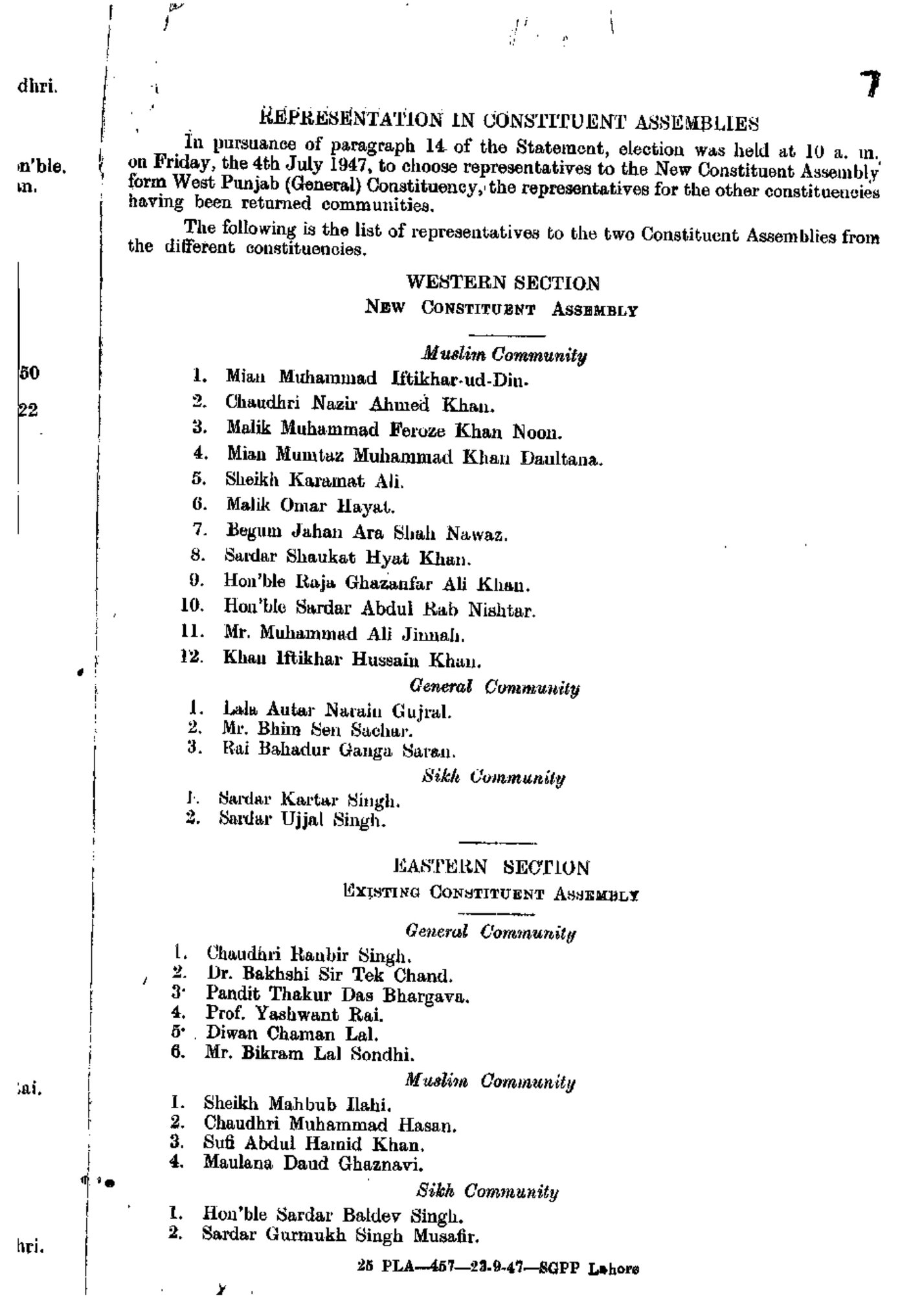
Punjab Assembly Document that will show you

Who was Who voted for the Partition of the Punjab in June 1947. Don't trust but check the document and watch a lecture on it delivered at the

Lyalpur Young Historian Club online series on the Punjab.

Punjab assembly was divided in Eastern & Western blocks. 


S, P Singha was Speaker of Western section consisting of Muslim majority districts while Depuy Speaker Sardar Kapur Singh headed Eastern section. There were 96 members in Western block and 72 members were in Eastern section or block who participated in the historic Punjab assembly session. Including two speakers 170 out of 175 members were attended it. As par Result of 1946 provincial elections ML had 73, Congress 51, Akalis 22, Unionists 20, Independents 7 and Ahrar 2 members in assembly. Who were absent among 5, is  still not known. 

In Western block out of 96 members 69 voted against partition and it included C E Gibbon, S P Singha and Khizar Hayat Tiwana. Only 27 members voted for the partition of the Punjab and they all were either Sikh or Hindu members. In Eastern block out of 72 members 50 voted for partition and 22 were against the partition of the Punjab. 

Fact we often hide from our youth in South Asia 

So out of 170 members 91 Punjab assembly members including 89 Muslim & two christian members voted against the partition of the Punjab. So more than 50% Punjab assembly members including non Muslim  leaguers voted against the partition of the Punjab in 1947. 

What happened in Bengal, needs further inquiry. 


Watch the lecture about the document delivered at 14 August 2020. 

Link

Partition, Punjab & 3rd June Plan: Some Facts


Further things on same topic

Partition of Punjab & Kashmir & its Impacts
( A 4 parts series)  What Went Wrong?

Saturday, August 22, 2020

Partition of Punjab & Kashmir & its Impacts ( A 4 parts series) What Went Wrong?


Partition of Punjab & Kashmir & its Impacts
( A 4 parts series)  What Went Wrong?

Sukh Dev Sohal (Amritsar), Aamir Riaz (Lhore), Harjinder Singh (Melbourne) , Gangveer Rathore Rahon along with Bikram Singh

Part 1: New Constitution, new political realities, reconciliation and denials 1935 - 1940.

Part 2: US, the New global leader, De-colonization and emergence of new political powers in British India. From Atlantic Charter of 14 August 1941 to December 1945 elections.

Part 3: 14 months that had changed the Punjab & Kashmir altogether, an unprecedented massacre and migration; history has not witnessed until today. From July 1946 to August 1947.

Part 4: Denial, Betrayal and conflict in post 1947 India and Pakistan. From 1947 to 2020.

Note: Series started at 15th August 2020, Till this time two parts are aired, 2nd part was aired at 22 August and rest others will air at 29 August & 5 September 2020. 

Watch the first part here

Part 1New Constitution, new political realities, reconciliation and denials 1935 - 1940.

Some important issues discussed in part 1

1.   Pre 1935 politics

·       3rd division of Punjab 1901. Muslims felt it as decrease in Muslim pollution percentage while non Muslim thought it as making another Muslim province while for colonial rulers it was part of 3 duck policy to counter Germans i-e (a) formation of Afghanistan as separate country other than British India in 1880s  (b) Erection of Durand line 1894 (c) Formation of NWFP & FATA. Beginning of Land alienation act and its politics. Shifting of battle of Urdu Hindi controversy in Punjab. Making of a new intelligence system IPI.

·       Gradual shifting of Centre from coastal  Calcutta to the borders of Punjab through Delhi Darbar politics and its reactions. 1877-1904-1911

·        Pagri Sanbhal jatta 1907

·       Shifting of Centre and expulsion of Delhi from Punjab 1911 December

·       McMahon Line 1914


·       Collapse of Ghadar movement 1914

·       Beginning of Gurdawara politics

·       Tricky Lucknow Pact 1916

·       Jillianawalla bagh massacre : End of Arms struggle & club politics & beginning of new spaces for people politics &  misleading movements, khilafat, Hijrat, non-cooperation etc

·       Linguistic Provinces resolution 1920

·       Swaraj & Shafi league politics

·       Gurdwara act 1925

·       Provincial elections 1920, 23, 26

·       Secret lease agreement for Chutta Tibet, (GB) from Maharaja Kashmir 1927

·       Nehru Report 280 pages 1928

·       Allahbad address 1930

·       First Kashmir movement 1930-1 & Punjab: a movement started by those who were out of State mainly in adjacent Punjabi districts or in cities where migrants were in meaningful number.

·       Communal award, beginning of Dalit politics, Lucknow pact revised. Ahrar, ML, Unionists supported but Congress & Akalies did not.

·       Shaheed Ganj and advice of fazl e Hussain

2.   Results of 1937 elections

·       Total seats 1585.. Congress 707 Independent 385  Muslimleague 106 (Bombay, UP, Bengal) Others 397

·       95 (Unionist Party), 14 (Khalsa National Board), 11 (Hindu Election Board), 10 (Akalis), 4 (Majlis-e-Ahrar-e-Islam), cong 18, Muslim League 1/2

3.   Reconciliation efforts by Jnnah: 6 letters between Jinnah & Nehru & answers 1937

4.   Arrogance of Congress to portray it as sole spokesman of British India. 1937

5.    Nearness between Muslim Majority provinces with ML, Inclusion of A K Fazlul Haq in ML, Sikender Jinnah pact 1937

6.    Amendment in Defense of India act 1915 and reactions as well as actions 1938

7.   Atrocities, communal policies largely anti Muslim, shift from Hindostani to Hindi, Urdu Hindi Controversy, Hindi Tamil Controversy, Banday Matram, Correspondence between Tagore & Subhash C Bose regarding Banday matram, Mahatma, Azad, Birla nexus against S C Bose who was President of Congress, Muslim mass contact movement ,  Two letters of Iqbal to Jinnah,  1938, that indicated two Muslim States within or outside British India. 

8.   WW2, resignation of Congress ministries just to  blackmail Colonial power, Day of deliverance by ML, closeness between Muslims of Minority & Majority provinces under ML, German radio & influence of Germans, Hitler Stalin secret meeting regarding Eurasia, Antiwar narrative of Ahrar and CPI, 1939

9.   English governor removed Hindi as essential subject in Madrass at 21 Feb 1940 that was the demand of Tamil protests since Congress rule 1937-9. Lhore Resolution 1940, exactly after ten years of Baghat Singh hanging, Punjab & Bengal premiers attended it, Authors  said that we followed US constitution based on federalism, No mention of Pakistan in resolution yet Pro Congress media called it Pakistan Resolution instead of Lhore Resolution. Protests & arrests continue against war efforts yet Congress remained confused in spite of out of power, book of Dr Ambedkar and smart suggestion to divide Punjab &  Bengal on communal lines 1940. 


Part 2 US, the New global leader, De-colonization and emergence of new political powers in British India. From Atlantic Charter of 14 August 1941 to December 1945 elections in British India.


1.    US & USSR were supporting China in AntiJapanese war since 1937

2.    Tri partite agreement signed between Germany Japan & Italy Sept 1940

3.     Throughout 1940, Germany & USSR were taking control of various nations including fall of France in June 1940 in favor of Hitler & bombing in UK.

4.    Lend & Lease politics , the law passed at 11 March 1941, US President got immense powers

5.    Attack of Hitler on USSR 22 June1941

6.    Atlantic Charter 14 August 1941

7.    Correspondence between Roosevelt & Churchill 1939-45, book of Peter Clark. 

8.    Attack on Pearl Harbor USA by Japanese  7 December 1941

9.    Conference of 26 countries in Washington 01 Jan 1942

10.                      Cripps Mission March 1942

11.                      INA and its politics

12.                      Defeat of Germany & Italy  mid 1943

13.                      End of Comintern, 3rd International May 1943

14.                      Tehran Conference December 1943… end of

15.                      The International Monetary Fund and the World Bank were both created at an international conference convened in Bretton Woods, New Hampshire, United States in July 1944

16.                      Yalta Conference Feb 1945

17.                      Defeat of Japanese June 1945

18.                      Use of  Atomic bomb in Japan August 1945

Politics in British India 1940-46 elections

19.                      Lala Lajpat Rai, Nehru Report & Ambedkar suggestion of communal division vs C R Formula, Allahbad address & Lhore resolution

20.                      August Offer 1940

21.                      Muslim League annual session 1941 in Madrass , dravidistan Justice party was with ML. E V Ramaswami Naicker Periyar.

22.                      National Defence council, Sir Sikandar included but left due to ML demand 1941.. in War council Ambedkar, noon, Sir Hormasji Pherozeshah Modi, Jogender Singh,

23.                      Cripps Mission March 1942 but since late 1941 it was on cards. Punjabi communistoon ka daftar meclord road lhore, inclusion of communists in training at Burma front, a book written by an indian communist.

24.                      2nd C R Formula April 1942 Rajgopal Acharya and Mian Iftiqaruddin along with 13 other congress working committee members.

25.                      July 1942 Lifting ban on CPI , but since late 1941 it was on cards. Punjabi communistoon ka daftar meclord road lhore, inclusion of communists in training at Burma front, a book written by an Indian communist.

26.                      Quit India resolution, too late, without Punjab, Bengal, Madrass, without Ahrar, Communists.. leaders arrested

27.                      Answer to Churchill from Roosevelt after quit india… do more

28.                      Death of Skandar 27 December 1942

29.                      Adhikari thesis. Support of CPI to AIML 1943-46

30.                      Anticommunist lobby in congress

31.                      Comparison of CPC & CPI

32.                      Gandhi Jinnah talks May 1944

33.                      Result of 1946 elections and an article

Punjab 175 Sindh 60 NWFP 50 Bengal 250=535

Cong    51              18               30             86= 185

AIML   73               27              17             113= 230

Others and independent                              =120

Percentage of nonmuslims in NWFP assembly?


Link of Part 2

Part 2 US, the New global leader, De-colonization and emergence of new political powers in British India. From Atlantic Charter of 14 August 1941 to December 1945 elections in British India. 


Part 3: 14 months that had changed the Punjab & Kashmir altogether, an unprecedented massacre and migration; history has not witnessed until today. From July 1946 to August 1947. 

It will air at saturday 5.30pm (Pak Time) 29th August 2020

Saturday, August 15, 2020

Barah Mah: An unusual Punjabi Journal ( Listen the discussion) Lok Lhar radio show


Barah Mah

 An unusual Punjabi Journal 

( Listen the discussion) Lok Lhar radio show

Guests: Zubair Ahmad, Parveen Malik (Punjabi Adbi Board), Pervaiz Vandal (Institute of Art & Culture), Mazhar Tirmazi (Poet & Intellectual) Jameel  Paul (writer,critic, editor & teacher) and Raja Sadiq Ullah (Poet). 

Barah Mah is a new anual Punjabi Journal and it has attracted Punjabi lovers after two issues. Its editors Zubair Ahmad & Amarjit Chandan deserved credit for it. At August 7, we did a radio show in which Zubair has informed about its genesis and threw light on writings published in it. Every big or small language  needs such journals and if it has good editors than people often remember it for centuries. 


A clip of Zubair Ahmad

https://www.facebook.com/aamirr/videos/10157898884889032/?t=25


we will share its Table of contents and extracts soon


Listen complete recording of the program by Clicking HERE


Monday, August 10, 2020

Concept of Nation, Iqbal, Jinnah & Religious minorities: Who are our Policy makers?


Concept of Nation, Iqbal, Jinnah & Religious minorities

Who are our Policy makers?

No doubt, our policy makers are either more visionary than Allama Iqbal & M A Jinnah or they have just ignored what was said, at least last 73 years history is witness to intentional divergences. 

Still after 73 years religious minorities are struggling for equal citizenship rights in Pakistan. It is contrary to what founders said and in below you will read it yourself. Interestingly, these quotes are from two basic documents, one written by Allama Iqbal and other penned by Quaid e Azam Muhammad Ali Jinnah. 

What went wrong is the core question, one should ask from policy makers. let us read these quotes. 

Allahbad address 1930, Allama Iqbal

The principle that each group is entitled to its free development on its own lines is not inspired by any feeling of narrow communalism. There are communalisms and communalisms. A community which is inspired by feelings of ill-will towards other communities is low and ignoble. I entertain the highest respect for the customs, laws, religious and social institutions of other communities. Nay, it is my duty, according to the teaching of the Quran, even to defend their places of worship, if need be. Yet I love the communal group which is the source of my life and behaviour; and which has formed me what I am by giving me its religion, its literature, its thought, its culture, and thereby recreating its whole past as a living operative factor, in my present consciousness.......

 the staunchest internationalist recognises that without the fullest national autonomy it is extraordinarily difficult to create the international State. So also without the fullest cultural autonomy – and communalism in its better aspect is culture – it will be difficult to create a harmonious nation."

11 August 1947, Policy Speech by M A Jinnah to First Constitutional Assembly

You are free; you are free to go to your temples, you are free to go to your mosques or to any other place or worship in this State of Pakistan. You may belong to any religion or caste or creed -- that has nothing to do with the business of the State.......

Now I think we should keep that in front of us as our ideal, and you will find that in course of time Hindus would cease to be Hindus, and Muslims would cease to be Muslims, not in the religious sense, because that is the personal faith of each individual, but in the political sense as citizens of the State.....

http://www.columbia.edu/itc/mealac/pritchett/00islamlinks/txt_jinnah_assembly_1947.html


آج اگست کی گیارہ تاریخ ہے۔ آج کے دن کو بانی پاکستان کی آئین سازاسمبلی میں کی گئی پہلی تقریر کے حوالے سے مذہبی   اقلیتوں  کے قومی دن کی حیثیت میں منایا جاتا ہے۔ 

یہ بات اہم ہے کہ علامہ اقبال کے خطبہ الہ آباد  1930اورقائداعظم کی  11 اگست 1947  کی تاریخی تقریرمیں جس تصور قوم کی بات کی گئی تھی اس  میں مذہبی، مسلکی،لسانی اور ثقافتی رنگانگیوں  کا احترام  قومی تشکیل کا جزو لاینفک تھا مگر افسوس کہ 73 سال بعد بھی  ہم  وطن عزیز کو علامہ اقبال اورقائداعظم کے 

تصورقوم کی عملی تفسیر نہ بنا سکے۔

علامہ اقبال نے خطبہ الہ آباد میں   قومی تشکیل کے حوالے سے کہا  تھا کہ جیسے  

عالمگیریت پر یقین رکھنے والاایک پکا شخض بھی جانتا ہے کہ ریاستوں کی خودمختاری کے بغیر عالمگیریت کا خواب پورا نہیں ہوسکتا  ویسے ہی  ثقافتی خودمختاریوں اور مذہبی آزادیوں کے بغیرقوم میں ہم آہنگی پیدا نہیں ہو سکتی۔


 11اگست کی تقریر میں  مذہبی آزادیوں کے حوالے سے بانی پاکستان نے برملا کہا کہ  آپ ریاست پاکستان میں  آزاد ہیں آپ آزاد ہیں  اپنے مندروں میں جانے کے لیے، آپ آزاد ہیں اپنی مساجد  یا دیگر عبادت خانوں میں جانے کے لیے۔آپ کا تعلق کسی بھی مذہب یا برادری سے ہو اس کا ریاست کے کاروبار سے کوئی تعلق 

نہیں ہونا چاہیے۔


ذرا سوچئیے۔۔۔۔۔۔ کیا ہمارے پالیسی سازوں،میڈیائی ناخداوں اور تعلیمی پردھانوں  نے ان گذرے 73 سالوں میں ان ارشادات کو وطنی تشکیل میں مقدم رکھا۔  آج بھی ہم منقسم ہیں تو اس کی وجہ یہی ہے کہ ہم نے مذہبی آزادیوں اور ثقافتی خودمختاریوں کو مقدم نہیں رکھا۔

 11اگست کا دن ہمیں یہ بھولا ہوا سبق یاد دلانے سے عبارت ہے۔


Wednesday, August 5, 2020

Why we forgot local Bodies? Politics of Decentralization & Twists. ( Radio discussion)


Why we forgot local Bodies? Politics of Decentralization & Twists.

 ( Radio discussion) 

Why we failed to develop a local bodies system in last 73 years? If State structure is heavily centralized (Thanks to colonial legacy) than how we can have a good & independent local bodies? Playing with decentralization is common in our history and we have witnessed how Ayub, Zia,Mushraff had played either to create new faithful politicians, reduce the power of major players like civil bureaucrats, provinces or to strengthen their illegal rule. 

Program was recorded at Lhore Studios of MastFM103 in regular #LokLhar show. Participants were Bushra Khaliq, Dr Imdad Hussain, Salman Abid & Raza Baqiry

A video clip of the show
Issues in Local government, those who are criticizing #PPP for not giving powers and funds to #Karachi , themselves cleverly deprived whole Punjab from it's elected local government representatives just in bughz e Nawaz Sharief. 

Click & Watch


 The first Local Bodies law was introduced in 1850, after a year from the annexation of the Punjab. In 1862 & 1882 it was further expand to few selected other areas but franchise remain very thin. In 1895, District boards were formed but till 1947, local bodies remained under bureaucracy. After 1947 we had a limited history of local body elections yet power circles guarded against it when in 1956/7 Jamat Islami swept local body elections in the Capital, Karachi. After imposing Marshallah, General Ayub banned politics, used hamour of corruption against seasoned politicians & civil servants, annexed newspapers like Pakistan Times but created a local bodies system. It created an ample space to misuse local bodies in power circles. 

let us lesson the complete show by clicking the link below

Punjab, International commitments & Human Rights along with Minority Affairs (Listen discussion)

Punjab, International commitments & Human Rights along with Minority Affairs

 (Listen discussion) 

Question of equal citizenship is included in our constitution yet in many ways its implementation is absent still after 47 years of signing the document known as 1973 Constitution. There are forces that are against the very much concept of equal citizenship in Pakistan. On the hand, Pakistan has signed numerous international conventions/treaties etc that ensured equal citizenship and to implement these commitments and uplift religious minorities, the Punjab Government had set up a new ministry in 2008. In order to fulfill international commitments Punjab Government had setup a Treaty implementation committee in 2016 and tried to implement minority quota in the Punjab. As par M Yousaf department is trying its best to implement minority quota. It is also a fact that our textbooks should also include lessons about non Muslim contribution in the Punjab in essential books like Urdu & English. It is to be noted that last government did published separate faith based textbooks for non Muslim Punjabi students from class 3 to 10 yet non the other provincial government did same. Remember the advise to introduce books under subject Ikhlaqiat was recommended in 2006 curriculum. Now other three provincial governments are trying to follow the Punjab in these affairs. 

Faces pakistan has introduced Muhammad Yousuf Deputy Director Human Rights & Minority Affairs, Punjab and he has explained what they did and ready to do in future. 

 M Yousaf played leading role in formulation of Human Rights policy of the Punjab and led the idea and establishments of Treaty Implementation cell Punjab which was appreciated by EU and recommended for other provinces in the same line. Also worked as Deputy Secretary minorities and successfully launched Minorities Empowerment package 2019.


Hate Speech, Uniform Curriculum & riddles in Education ( Radio Discussion) MastFM103, LOK LHAR


Hate Speech, Uniform Curriculum & riddles in Education ( Radio Discussion)

  MastFM103, LOK LHAR

What is Hate Speech? Why it is important to address it in our policies? What do you mean by uniformity? is there any difference between uniformity & equality? Can we achieve equality without uniformity? What is Tahfaz e Islam bill and what is the politics behind it? 


With the help of Faces Pakistan we have invited Zeba Tahir Hashmi. Zeeba T. Hashmi is an opinion writer and peace educator based in Lahore. She has former experience of working as Advisor to Pakistan Mission to United Nations, New York. Further, she has covered education and political issues related to religious minorities and have presented papers, case-studies and fact-finding mission reports on social persecution of the marginalized for different organizations. As a peace educator, she has also developed a peace education training manual for the teachers with an aim to address the issue of hate and controversial content found in textbooks and to promote interreligious friendships between different faith groups. She also works for promotion of health education and develops communication strategies and research to understand barriers to basic social services and facilities. She has also worked with slum communities for improving their access to basic social services and highlighted on opportunities that can be created from social enterprising initiatives. Recently, she has co-founded Peace Dialogue Series where she is using the platform for effective peace communications for various marginalized groups.


A video clip of the show
We are reducing spaces of public debate in #Pakistan and like Zia era, this time too #usa is with those who are reducing public debates. in US they will not allow it but in #India and Pakistan like countries they support tyrant regimes

Another clip of the show
Managing education through the eyes of interior cum security point of view rather then acknowledge is the legacy we are still following and it is the core issue.


Listen the complete program 

Punjab Di Vel 1799-2025 All in One (Shahmukhi, Gurmukhi, English, audio, video, photos)

  All I know is this book "Panjab di Weyl" by Aamir Riaz TuTu will unlearn everything we've been taught/told so far about Panj...