Thursday, September 19, 2019

Remembering Ahmad Rahi ( A radio Show at Lok Lhar)

Remembering Ahmad Rahi 

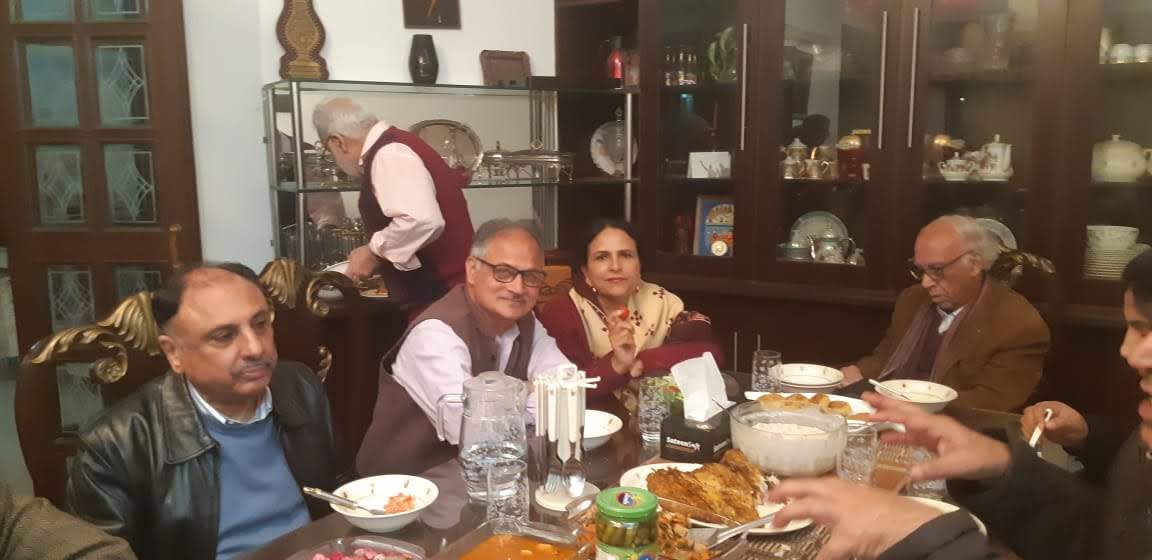
A radio show recorded at mastfm103 in memory of great Punjabi editor, poet and political worker born in Amritsar at 2 November 1923 and died in Lahore at September 2, 2002. At his 17th death year we did a program at September 6th 2019. 
Guests: Khalid Mansor, Nain Sukh, Tahir Asghar and Abdur Rauf Malik 

You may find his autobiographical details at https://en.wikipedia.org/wiki/Ahmad_Rahi


Complete recording of the show.


Flap of Punjabi poetry book Tranjan written by Sadat Hasan Manto in 1952 reproduced in Abdur Rauf Malik's book Surkh Salam published by Jamhori Publications Lhore. 


Some useful links of Ahmad Rahi for further knowledge.

Book Tarinjan

http://apnaorg.com/books/trinjan/trinjan.php?fldr=book

Songs of Rahi the great
http://www.dareechah.com/modern_punjabi_poetry/ahmad_rahi_song_videos

Tuesday, September 10, 2019

Without respecting diversity, no democracy can flourish. ( A radio discussion)


Without respecting diversity, no democracy can flourish. 
( A radio discussion) 


Respect of diversity is among the basic pillars of democracy yet in South Asia in particular it is largely missing since colonial times till today. Interestingly after emergence of Trump, Li Pin type white supremacy syndrome respect for diversity is facing serious challenges even in so-called advance world.  Just to understand ground realities we did a radio discussion in weekly Lok Lhar show (Every Friday from 2 to 4) on this topic. 
It was recorded in  Lhore studios 30th August 2019 at MastFM103.


Issues of not respecting diversity in Pakistan. 
Guests: Rashida Qureshi , Rizwan Butt, Gurmeet Singh & Azam Malik. 
Rashida Qureshi works with Search for Justice. She did M A economics from BZU Multan. 
Rizwan Butt a businessman, from Darugh e wala, Lhore. A social worker and ex-vice chairman UC 134.
Gurmeet Singh FirstSikh broadcaster in FM radios of Pakistan. Works with electronic media and promoter of Tourism in Pakistan.
Azam Malik a publisher, worked in developmental sector and secretary of Punjabi Sangat Pakistan.

Link of the complete radio show


Tuesday, September 3, 2019

Rise & Fall of democracies and Sino-American conflict in post cold war era. Can Trump handle it?


Rise & Fall of democracies and Sino-American conflict in post cold war era.

Can Trump handle it? 

What Trump is doing is not a new thing but it is continuation of an old policy in different packing. ٰIs democracy still a main deterrence  against anti-people aggression? Misuse of campaigns for Rights & democracy are on cards. Love with Hong Kong but silence on Kashmir, Palestine or vice versa is enough to understand gimmicks of power play.    
In his book (Published in 1992) American out of box thinker Noam Chomsky had revealed that future US rulers would be more brutal then their predecessors and would use hammer extensively to control the disturbed balance  of post cold war crisis. 
Although Chomsky was more clear on cold war mantra, designed in post WW2 era to protect US interests and deconstructed so-called ideological camp theory well yet his analysis of US ruling elite threw ample light on future. Even after 28 years, it is more close to reality in many ways. He wrote that the United States has deliberately fought against democratic, progressive movements in order to pursue its coercive, capitalist interests. 
At that time China was in making yet deterioration of USSR was on cards. Like early 1950s & late 1960s, UK unsuccessfully tried to use it in favor of her but finally compelled to play the role of subservient agent under US WOT. 
  
In a review of Chomsky's book writer had explained US interests as,
'' Noam Chomsky's latest book, Deterring Democracy, is an exhaustively researched , impassioned and reasoned analysis of American foreign policy. It defies dismissal. Chomsky argues that the United States historically has pursued "stability" instead of "democracy" overseas while claiming to pursue both. These two pursuits, Chomsky asserts, are incompatible because democratic history is an unstable terrain, a dialectical process wherein laboring classes (peasants, urban proletarians, trade unions) struggle against repressive regimes (corporate, military and political elites). In the midst of these inevitable conflicts and in an age ofcapital-intensive modernization, urbanization and surplus labor, twentiethcentury American foreign policy has been made. The U.S. Government, Chomsky persuasively argues, is ruled—albeit democratically—by a politico-corporate elite that has consistently sided with repressive regimes in the developing world, whose "assigned 'function' . . . has been to serve the needs of the industrial West." American business elites have demanded access to overseas markets, cheap labor and primary resources which repressive governments have been willing to exploit for a price. That price has been American financial, military and diplomatic support for regimes which in turn stifle democratic reform movements through violence, coercion, death-squad killings and widespread jailings. Chomsky further suggests that the United States has perpetuated an ideological system that masks these practices because they are morally reprehensible . The press, he shows, serves the corporate-governmental elite by defending and disguising U.S. Governmental hostility towards the political and economic freedom of laboring classes throughout the world. Chomsky addresses in detail the press's ideological commitment to the state's exceptionalism and "democratic mission." Chomsky establishes, therefore, that the United States has deliberately fought against democratic, progressive movements in order to pursue its coercive, capitalist interests''

If you analysis post 1990 Pakistan you may easily find implementation of US interests against democracy by the non-elected elite well. Not a single government or political party could review Pak-US relations. US role expanded in South Asia in post 9/11 era and in his book ON China Henry Kissinger threw ample light on it. Re-emergence of China Containment policy  expanded ample spaces for the elite of India & Bangladesh to save their petty interests. uring 1990s, the mantra of Offshore investments was coined to strangle Non-British & Non-US elite and it is serving well even in 2019. The mantra was, '' if you can control elite, you can influence deep states''. One may check rise of anti money laundering gods in this perspective too. But these arrangements were not enough to control things so civil rights campaigns and democracy got ample space in US foreign policy agenda to combat others.
To be continue


Monday, August 26, 2019

Is G7 a representative economic body or just an eye wash? What is the hidden agenda?

Is G7 a representative economic body or just an eye wash?

 What is the hidden agenda?

G7 consists of 7 big & small, powerful & weak countries. Italy is politically weak yet Canada & Japan are running their political cum defense affairs more close to client States. Other 4 nations or countries in G7 are UK, France, Germany & US. When it was formed in 1975 during Cold War days, it was G6 yet lateron Canada was invited. In 1997 it became G8 when Russia was invited (In his book Journey Tony Balir claimed that US was against entry of Russia yet British diplomacy had outmaneuvered it) yet in 2014, it again shrunk to G7 and now in 2019  Trump is trying to re-invite Russia, thanks to AntiChina mantra. 

It is interesting that if G7 is an economic body than why the majore economic player China is out of it? All the 4 major players in G7 want to use the body as par their foreign policy initiatives. US invitation for Russia is in Bghuz e China and that is why India was invited as guest. Interestingly as par Guardian newspaper US was surprise to see Iran there but happy to see India.
Despite White House concerns over Iran, however, the following morning US officials were “surprised” by Macron’s invitation to Iranian foreign minister Mohammad Javad Zarif. 

Interestingly  Trump had demanded India to withdraw from S-400 Russian deal but same time insisting G7 countries to add Russia. So Europeans invited Iran just to balance it. Other then China & Iran issues, these 4 major players have sharp differences on the question of Brexit and future of EU. 

There is a long history of protests against so-called great nation summits and even today supporters of climate change are on roads.

Pressure on India & Iran is visible yet both have enough room to escape. Russian President is smart enough to show his reentry but neither ready to leave SCO.
Russian President Vladimir Putin said this week that his country saw any form of dialogue with G7 nations as useful

Is Trump ready to remove sanctions on Russia imposed after Crimea and Ukraine too? Europeans especially Germany will ask US before hand. In either way, if Trump is adamant to escalate Anti China, derive he must be ready to compromise more. He has to die either in deep sea or fire. 

Friday, August 23, 2019

Kashmir: What Next? Iranian type multinational treaty may satisfy all key players including Kashmiris.


Kashmir: What Next?

Iranian type multinational treaty may satisfy all key players including Kashmiris

What next in #Kashmir? India has done what they want but it will not resolve the issue. In fact due to the 5 August decision now #China has announced that it is a party in Kashmir issue. Kashmiri resistance movement have been entered in a new phase. What current government did is another pathetic story. We discuss it in our weekly Friday show Lok Lhar recorded at Lhore Station 23rd August 2019. Listen the recording, Professor Aziz u din Ahmad too talk on phone and share his views about Kashmir.

Link of the complete
https://vocaroo.com/i/s0IUz1dmzYtf


Even today when we are filing this post international press is reporting burning of Kashmir.
Paramilitary troops deployed to guard against possible protests as New Delhi-imposed lockdown continues for 19th day

 Our FRANCE 24 team headed inside Indian Kashmir, at the foothills of the Himalayas, where they witnessed the first few days of the blockade. This is their exclusive report.
Exclusive report: lockdown in Kashmir


After UNSC close door meeting, it is important to understand that although all 15 members agreed on atrocities done by Indian State in Indian Kashmir and registered their reservations against restrictions imposed on people but US & France reluctance was registered too. Thanks to Modi government grey areas has been removed by Indian government himself. Since 1948 till 21 December 1971, Kashmir remained had a space in UNSC but after Shima accord it was decided that both India & Pakistan would resolve it mutually. In that accord there was a reference of UNSC. UNSC resolution 307 had demanded as,
''  a durable cease-fire and cessation of all hostilities in all areas of conflict be strictly
observed and remain in effect until withdrawals take place, as soon as practicable, of all armed forces to their
respective territories and to positions which fully respect the cease-fire line in Jammu and Kashmir supervised by the United Nations Military Observer Group in India and Pakistan''


To avoid UNSC resolution India had signed Shimla agreement in July 1972 so no third party could decide their fate. So India had accepted Kashmir as a controversial issue between both countries.  In 1999, India again reinforced it and signed Lhore Agreement with Pakistan.  


Struggle of Kashmir enters in a new phase and it needs new narrative (Radio talk)


Tuesday, August 13, 2019

Travelogue of Pakistan by Sukirat Singh Anand ( A series of articles)


Travelogue of Pakistan

by Sukirat Singh Anand 

( A series of articles)


Link of Part 1
http://www.wichaar.com/news/119/ARTICLE/34138/2019-08-14.html

Link of Part 2
http://www.wichaar.com/news/119/ARTICLE/34139/2019-08-19.html

continue , will upload other parts as soon as it publish at Wichaar


Pictures of Part 1


Pictures of Part 2


Pictures of Part 3


Religion based Cold War strengthened religious fundamentalism across borders.

                   Interview Sukirat Singh Anand by aamir Riaz for The news on Sunday


Struggle of Kashmir enters in a new phase and it needs new narrative (Radio talk)


Struggle of Kashmir enters in a new phase and it needs new narrative (Radio talk)

Kashmir struggle has entered in a new phase after new #Indian move of changing status of #Kashmir by Indian establishment through a constitutional amendment. Like infamous #ChenabFormula this move is too based on permanent division of old state of J&K. Although Pakistani PM said that it was in the election program of Nerander Modi who took oath 2nd time at 30th May 2019 yet government of Imran Khan did not took any notice regarding that move in 66 days. That is why some observers said that it was pre-planned but some said it was smart move by Indians. What India did is understood yet why our foreign office have no clue of it since May 30th? 
State of J&K was created by colonial rulers in 1846 when they won a battle against Lhore Darbar and had included Hazara, Jammu, Serinagar, Gilgit baltistan ( Chotta Tibet) and many more areas in it. In Mughal Times Kashmir was part of Subah Lhore. During Ranjit Singh times areas included in J&K were districts & Subdistricts of Lhore Darbar. Interesting in Ranjit times, two Sheikh brothers had ruled Kashmir till 1846 yet it was colonial rule that had made Gulab Singh of Jammu as its new ruler. Without understanding political, social and financial background of state of Kashmir during Raj 1846 till 1947, it is not possible to understand kashmir issue. the most important part of that period is 1930-31 movement against Dogra Raj. Why british government took G&B from Maharaja kashmir for 50 years of lease in late 1920s is the vital question. At the time of partition why colonial rulers included Muslim majority GurDaspur district in India is the vital question. As par 1941 census Gurdaspur had 51.2 percent Muslim population and it was only land link with Bharat. After 1947 what happened with Kashmir in India and Pakistan  is also an interesting story that have many lessons in it. You can listen recording of the radio show recorded at MastFM 103 Lhore studio at August 9, 2019.

Link of the news about program

کشمیر دی سیاستاں۔ پچھوکڑ، چلدا ویلہ اتے آون والے دن۔سپیشل سٹیٹس مکاون نال مسلہ ہور چوڑ ہو چکیا ہے۔یکطرفہ حل نہیں چلنے۔ (سنو ریڈیو پروگرام)


Link of complete Radio recording
https://vocaroo.com/i/s0DOtDTVIgLF

Oct 7, 1958 in Pakistan and its analysis

اکتوبر7دا منحوس دن کیوں آیا؟ اسی کدوں تیک ویروے کریندے ہوئے شخصصیات اتے فوری ہوئے وقوعیاں بارے تبرّا کریندے رہواں گے۔۔۔۔عالمی تے مقامی حقیق...